Paran Lines in Astrocartography: What They Are & How to Find Yours
A paran is a latitude where two of your planets were on angles at the same moment: one rising, setting, culminating or on the IC while the other did the same. On an astrocartography map a paran runs east to west through the point where two planetary lines cross, and it reaches every place within about 1° (70 miles) north or south of that latitude. This guide covers what paran lines are, why they share a latitude with line crossings, how wide they reach, whether you need a birth time, and how to find yours.
What Is a Paran in Astrocartography?
Every planet in your chart draws four lines on the map, one for each of the four angles: where it was rising (ASC), culminating overhead (MC), setting (DSC), and at the lowest point beneath you (IC) at the moment you were born. A line answers one question: where on Earth was this planet on an angle?
A paran asks where two planets were on angles at the same moment. The answer is never a single spot. It is a whole circle of latitude running all the way around the world. Anywhere on that latitude, the turning sky brought both planets to their angles together, so astrologers read the two planets' themes as working as a pair there.
The word comes from the Greek paranatellonta, "rising alongside", the old name for stars that come up over the horizon at the same time. Bernadette Brady's work on fixed stars brought parans back into wide use in modern astrology, and in astrocartography they show up wherever two lines meet.
Paran Lines vs. Line Crossings
Most people meet parans as line crossings: the spot on the map where, say, a Venus ASC line cuts through a Jupiter MC line. The crossing and the paran sit on the same latitude, for a simple reason. As the Earth turns, every line on your map slides west at the same speed. Two lines that cross at 38°N keep crossing at 38°N as they slide, so the crossing point travels around the world along that latitude, and every place on 38°N gets its turn with Venus rising as Jupiter culminates.
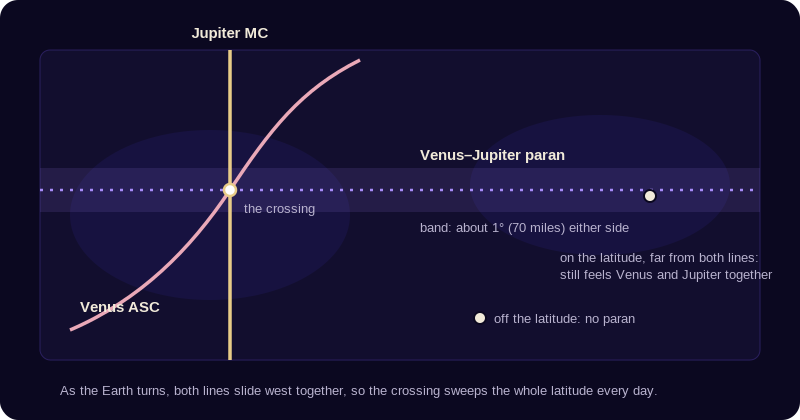
That gives you two ways to feel the same pairing:
- Near the crossing, you get both lines and the paran at once. This is the classic hot spot most guides talk about.
- Anywhere else on the latitude, you get the paran alone: the two-planet theme without either line running through town. This is why a city with no line nearby can still carry a strong pairing.
Two MC or IC lines never cross, since both run straight north to south, so those meridian pairs form no parans.
How Wide Is a Paran?
Most astrologers allow about 1° of latitude on either side of a paran, roughly 70 miles or 110 km. Inside that band the pairing counts, and the closer a place sits to the exact latitude, the stronger it reads. Past about 1° it fades into the background.
Because parans circle the globe, a typical chart has more than a hundred of them. That sounds like a lot until you narrow it to one city: most places sit within 1° of one or two parans, and roughly a quarter to a third sit near none at all.
How to Read a Paran
Every paran pairs two planets, each on an angle. The classical wording helps: a planet rises on the Ascendant, culminates on the Midheaven, sets on the Descendant, and reaches the IC at the bottom of the sky. "Venus rises as Jupiter culminates" reads as love and ease arriving together with luck and growth.
Start with the planets, because they set the theme:
| Planet | What it brings to a paran |
|---|---|
| Sun | Confidence and recognition |
| Moon | Feeling and belonging |
| Mercury | Ideas and conversation |
| Venus | Love and ease |
| Mars | Drive and nerve |
| Jupiter | Luck and growth |
| Saturn | Effort and structure |
| Uranus | Change and freedom |
| Neptune | Imagination and sensitivity |
| Pluto | Intensity and transformation |
| Chiron | Old wounds and healing |
| North Node | Growth and direction |
Then read the angles for where in life it lands: the Ascendant is how you come across, the Midheaven is career and reputation, the Descendant is relationships, and the IC is home and family.
A few pairings people ask about:
- Venus and Jupiter: love and ease meet luck and growth. The most sought-after paran for relationships and for enjoying where you live.
- Sun and Saturn: recognition that comes through effort. Slow to build, and it lasts.
- Mars and Uranus: drive meets sudden change. Exciting and restless; it goes best with a real outlet.
- Moon and Neptune: feeling meets imagination. Good for art and retreat, harder for clear boundaries.
- Venus and Saturn: love that wants commitment. Serious relationships, fewer casual ones.
Which Parans Matter Most?
With more than a hundred parans in a chart, a little filtering goes a long way:
- Tight ones first. A paran within about a third of a degree (25 miles) of a city reads stronger than one at the edge of the 1° band.
- Match your question. Moving for love? Weight Venus, Moon and Descendant parans. For career, look at the Sun, Jupiter, Saturn and the Midheaven.
- Favor planets that matter in your birth chart. A paran with your chart ruler, or with a planet that sat close to an angle when you were born, carries more weight.
- Watch for a line plus a paran. If a planet's line also runs near the city, a paran with that same planet adds to it.
Do You Need an Exact Birth Time for Parans?
Less than you do for lines. A wrong birth time shifts every line on your map east or west, by about 15° of longitude for every hour of error. Paran latitudes barely care, because they depend on where the planets sat in the sky, and the planets move slowly through a day. (The Moon is the exception.)
We compared paran latitudes for the first and last minute of 40 different birth days, which is the worst case if all you know is your birth date:
| Paran between | Typical shift across the whole day | 9 in 10 move less than |
|---|---|---|
| Two of Jupiter, Saturn, Uranus, Neptune, Pluto and the North Node | 0.04° | 0.35° |
| The Sun, Mercury, Venus or Mars and any other body | 0.5° | 3° |
| The Moon and any other body | 11° | too far to use |
So if you only know your birth date, your slow-planet parans already sit on the right latitude and your inner-planet parans are close. Moon parans should wait until you have a birth time.
How to Find Your Parans on StarMapper
StarMapper works as a free paran calculator, computed in your browser with no sign-up:
- Draw your free map with your birth date, time and place.
- Click any line. White dots mark where it crosses other planets' lines, and a dashed line runs east to west through each dot. Each dashed line is a paran.
- Search a city under the map. The city panel lists the parans at that city's latitude within 1°, closest first, with what each pairing means and where the two lines actually cross.
Frequently Asked Questions
What are paran lines in astrocartography?
A paran line is a latitude where two of your planets were on angles at the same moment: one rising, setting, culminating or on the IC while the other did the same. On an astrocartography map it runs east to west through the point where the two planets' lines cross, and it reaches every place within about 1° of latitude (roughly 70 miles) north or south of it.
Is a paran the same as a line crossing?
They share a latitude. The crossing is one point on the map; the paran is the whole circle of latitude through it. As the Earth turns, both lines slide west at the same speed, so the crossing sweeps along that latitude and every place on it gets the same pairing. Near the crossing you feel both lines and the paran; elsewhere on the latitude you feel the paran alone.
How wide is a paran?
Most astrologers allow about 1° of latitude either side, roughly 70 miles or 110 km. The closer a place sits to the exact latitude, the stronger the pairing reads. Past about 1° it fades into the background.
Do I need an exact birth time for parans?
Less than for lines. A wrong birth time moves every line east or west by about 15° of longitude per hour, but a paran's latitude depends on where the planets sat in the sky, which changes slowly. Parans between the slow planets (Jupiter through Pluto, and the North Node) barely move even across a whole day of possible birth times. Parans with the Sun, Mercury, Venus or Mars usually move about half a degree. Moon parans need your birth time.
Is a paran stronger than a planetary line?
Astrologers usually read a paran as subtler than living right on a line, but it covers far more ground: a whole band of latitude instead of one corridor. A city that sits on a planet's line and also on a paran with that planet gets the planet twice over, and the paran's partner planet colors how it shows up.
How do I find my parans?
Draw your free map on StarMapper and click any line: a dashed line runs east to west through each white crossing dot, and each one is a paran. Or search a city under the map: the city panel lists the parans within 1° of that city's latitude, what each pairing means, and where the two lines actually cross.
See Your Parans on the Map
Which pairings run through the places you love, or the ones you're thinking of moving to? Generate your free astrocartography map, click any line to see its parans, and search a city to see every paran at its latitude. No sign-up required.