How to Read an Astrocartography Map in 7 Steps (With Pictures)
Your astrocartography map looks like forty-eight coloured threads thrown across the world. That is exactly what it is, and reading it comes down to seven questions you ask about each thread: which planet, which angle, how close, what it combines with, and whether your own life agrees. This guide walks through them in order, with a worked example at the end. By the last step you will be able to look at any city and say, in a sentence, what your map thinks of it.
If you have not drawn your map yet, do that first: the free astrocartography chart takes your birth date, time and city and draws every line in a few seconds. Keep it open in another tab and follow along on your own lines rather than ours.
Before you start: get your birth time right
Every step below depends on your birth time. The planets' zodiac positions barely move in an hour, but the four angle lines are drawn from where the horizon and meridian were pointing at your birth minute, and those move about one degree every four minutes. A time that is twenty minutes off shifts your MC lines by roughly five degrees of longitude, which in Europe is a whole country. Check a birth certificate or a hospital record if you can, and treat a remembered "around breakfast" as a rough sketch rather than a verdict.
Step 1: Tell the four lines apart by their shape
Each planet draws four lines, one for each angle of the chart. You can tell them apart before reading a single label, because the shape gives the angle away.
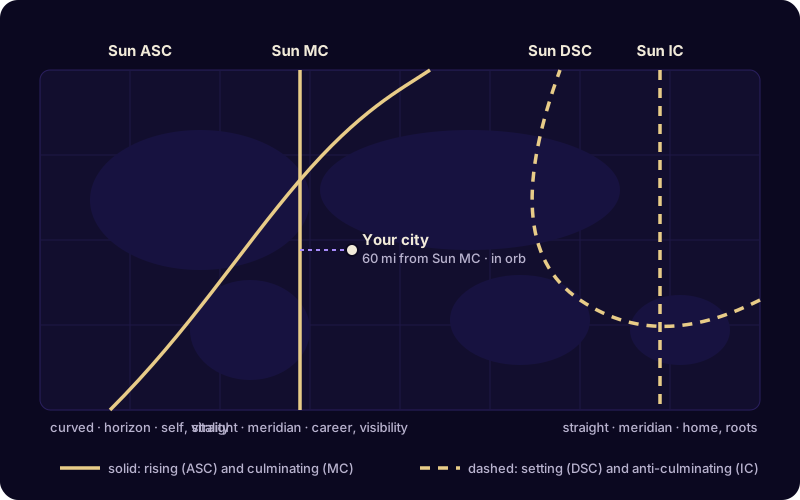
- MC and IC lines are straight and run north to south. They mark the meridian: the planet was at its highest point (MC) or its lowest point (IC) at your birth. They sit exactly 180 degrees of longitude apart.
- ASC and DSC lines curve. They mark the horizon: the planet was rising (ASC) or setting (DSC). Their curve depends on latitude, which is why they sweep across the map and sometimes loop.
| Angle | Shape on the map | Life area it governs | The question it answers |
|---|---|---|---|
| ASC (Ascendant) | Curved | Identity, vitality, how you come across | How do I feel in my own skin here? |
| MC (Midheaven) | Straight | Career, reputation, public life | Could I build something here? |
| DSC (Descendant) | Curved | Partnerships, the people you attract | Who do I meet here? |
| IC (Imum Coeli) | Straight | Home, roots, emotional foundation | Could this feel like home? |
The deeper guides to each angle are the Ascendant, the Midheaven, the IC and the Descendant, or start with the four angles overview. For now, straight means career-and-home axis and curved means self-and-relationships axis, and that is enough to keep going.
Step 2: Identify the planet, and never guess the colour
Every planet keeps one colour across all four of its lines, so a Venus line is the same shade whether it is Venus ASC or Venus IC. The legend beside the map lists every colour. On StarMapper you do not have to squint: click or tap any line and the panel names the planet and the angle and opens its interpretation. Do that for every line you are about to read rather than matching colours by eye, because two planets can share a similar hue on a busy map.
Each planet-angle pair has its own page with the full meaning, best uses and where it is strongest. The complete index of all 48 lines is the reference to keep open while you read.
Step 3: Check the distance. Lines have reach, not edges
A line is not a wall you are either on or off. Its influence is strongest within about 70 miles (110 km), fades steadily out to roughly 300 miles, and becomes background beyond that. Astrologers call this distance the orb.
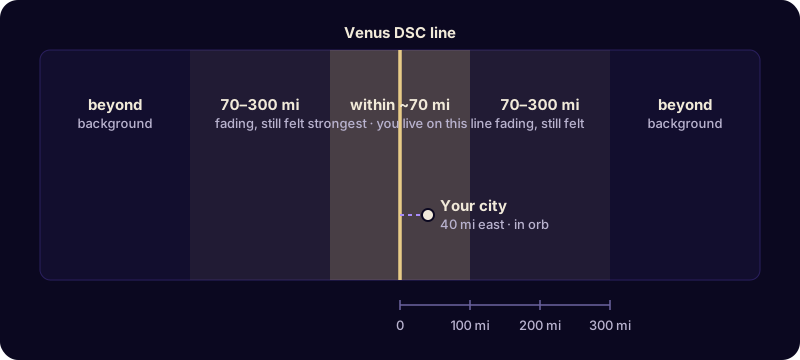
In practice: zoom into any city on your map and the city panel lists every line within range and the distance to each, in miles and kilometres. A line 30 miles away is the headline of that city. A line 250 miles away is a footnote. If no line comes within 300 miles of a city, your map is simply neutral about it, which is its own useful answer.
Step 4: Read the combination, not the line
The meaning of a line is the planet's theme expressed through the angle's life area. Sun is identity and vitality; on the MC that becomes public recognition, on the IC it becomes a home that feels like yours. Hold the two words together and the reading usually writes itself.
| Line | What it tends to feel like | Read the full page |
|---|---|---|
| Sun MC | Visible, recognised, a career that fits | Sun MC line |
| Moon IC | A place that feels like home within weeks | Moon IC line |
| Venus DSC | Partnerships, romance, the people you attract | Venus DSC line |
| Jupiter MC | Luck in work, doors opening, growth | Jupiter MC line |
| Mercury ASC | Sharp, talkative, good for study and networking | Mercury ASC line |
| Saturn ASC | Serious, disciplined, slow to warm up | Saturn ASC line |
| Mars DSC | Intense, competitive relationships | Mars DSC line |
| Pluto IC | Deep transformation of home and family life | Pluto IC line |
No line is purely good or bad. Venus and Jupiter feel easy; Saturn and Pluto are demanding but build mastery. The right line is the one that matches what you want from the place, which is why Step 7 matters.
Step 5: Look for crossings
Where two lines cross, both planets are angular at once and the location carries both themes. Astrologers call the crossing a paran, and a paran within about 70 miles of a city is stronger than either line alone.
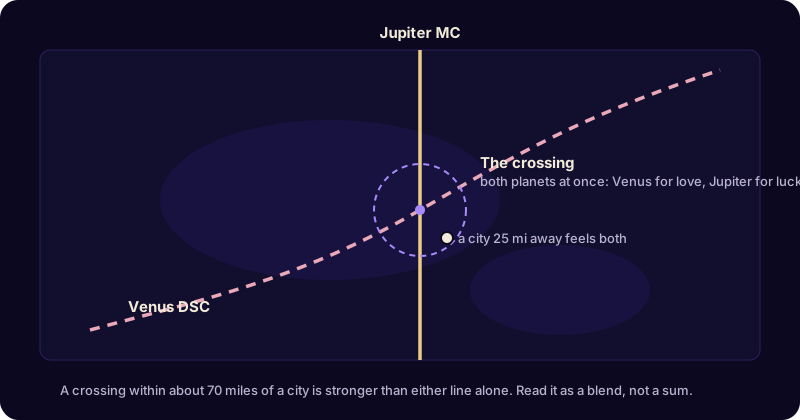
Some combinations worth knowing:
- Venus and Jupiter: one of the most favourable, where love, abundance and ease converge.
- Sun and Mars: drive and energy, good for athletic or entrepreneurial chapters.
- Saturn and Pluto: demanding, but it can force deep structural change.
- Moon and Neptune: intuitive and spiritual, with a risk of emotional fog.
Read a crossing as a blend, not a sum. Venus crossing Saturn is not "love plus limits" so much as a slow, committed kind of love.
Step 6: Calibrate with places you have already lived
This is the step most people skip, and it is the one that makes the map yours. Write down three places you have spent real time: where you grew up, a city you moved to, a trip that changed something. Find each on your map and note the lines within 70 miles. Then ask whether the reading matches the memory. If your Saturn IC line runs through the town where you felt lonely at nineteen, you now know how Saturn IC speaks to you. If a Venus DSC line sits on the city where you met your partner, you know that line delivers. You will trust the rest of the map in proportion to how well it explains your past.
Step 7: Decide what you are actually asking
A map answers different questions at different scales, so name yours before you act on it.
- A weekend or a holiday. A line gives you its flavour within days. Pick a city on a Venus or Jupiter line and enjoy it; do not plan a life around it. The trip planner does this for a whole group at once.
- A year or a move. Here you want the full chart for that one city, not just the lines through it. A relocation chart recasts your birth chart for that place and shows which house every planet lands in, which is what decides how living there actually feels.
- A decision between two cities. Compare the lines within 70 miles of each, then compare the relocation charts. The place with a Jupiter MC line and a Saturn ASC line is a different proposition from the place with a Venus DSC line and nothing else.
A worked example
Say you open your map, zoom to Lisbon, and the panel shows a Venus DSC line 40 miles to the east and a Jupiter MC line 180 miles to the north. Step 1: the Venus line is curved, so it is a horizon line, and DSC means relationships. Step 2: you click it and confirm it is Venus. Step 3: 40 miles is well inside the strongest band; 180 miles is a fading influence. Step 4: Venus through the Descendant reads as partnership, attraction, the people you meet. Step 5: the two lines do not cross near Lisbon, so there is no paran to add. Step 6: you remember that the last Venus DSC city on your list was where you met your closest friend, so you trust it. Step 7: if you are asking about a holiday, Lisbon is an easy yes. If you are asking about moving, you open the relocation chart for Lisbon and see where your Sun, Moon and Saturn land before deciding.
That is the whole method. Four shapes, one colour per planet, a distance, a combination, a crossing, a memory, and a question.
The planets at a glance
| Planet | Brings | Strongest on |
|---|---|---|
| Sun | Identity, vitality, being seen | MC for career, ASC for confidence |
| Moon | Emotion, comfort, belonging | IC for home |
| Mercury | Communication, learning, networks | ASC and MC |
| Venus | Love, beauty, pleasure, art | DSC for love, ASC for charm |
| Mars | Drive, ambition, friction | MC for ambition, DSC for intensity |
| Jupiter | Expansion, luck, opportunity | MC for career luck, ASC for optimism |
| Saturn | Discipline, structure, limits | MC for lasting achievement, slowly |
| Uranus | Change, invention, surprise | ASC for reinvention |
| Neptune | Spirit, imagination, blur | IC for retreat, ASC for art |
| Pluto | Power, transformation, depth | IC and ASC for life-remaking change |
Each planet's lines are described in full on its line pages.
Frequently Asked Questions
How do I know which astrocartography line is closest to me?
Open your map and zoom to your city — StarMapper shows which lines pass nearby and how far away each one sits, in miles and kilometers. Anything within about 70 miles is considered active. The closest lines exert the strongest pull.
What do the colors on an astrocartography map mean?
Each planet has its own consistent color across all four of its lines, so you can tell a Venus line from a Saturn line at a glance. A legend next to the map maps every color to its planet; the angle (ASC, MC, IC, DSC) is shown when you click or hover a line.
What happens when two astrocartography lines cross?
A crossing (or paran) blends both planets' energies in that location, which can amplify or complicate them. A Venus–Jupiter crossing is famously fortunate; a Saturn–Pluto crossing is intense. Crossings can make a spot feel significant even when no single line runs right through it.
Are some astrocartography lines good and others bad?
No line is purely good or bad — it depends on what you want. Venus and Jupiter lines feel easy and lucky; Saturn and Pluto lines are demanding but build mastery and transformation. The "right" line is the one that matches the area of life you're trying to activate.
Do I have to live exactly on a line to feel its effect?
No. Influence is strongest within about 70 miles and fades gradually out to a few hundred. You can absolutely feel a line from a nearby city, and a short visit gives you a taste of its flavor.
Open your map, pick the city you keep thinking about, and run it through the seven steps. If you would rather have it read for you, the Full Report walks every line on your map by life area and names the cities where each one lands.